

Your questions answered · Dealing with a builder
Variations: why the price changed,
and when it shouldn't have.
The number one complaint about builders in Australia isn't bad work. It's the price that moved. Most of the time it moved through a variation, and Queensland has clear rules about how those are supposed to happen. Here they are, plus the honest part: some variations are on us, not you.
 Nathan Brain, carpenter and builder at Sabre
17 September 2026
5 min read
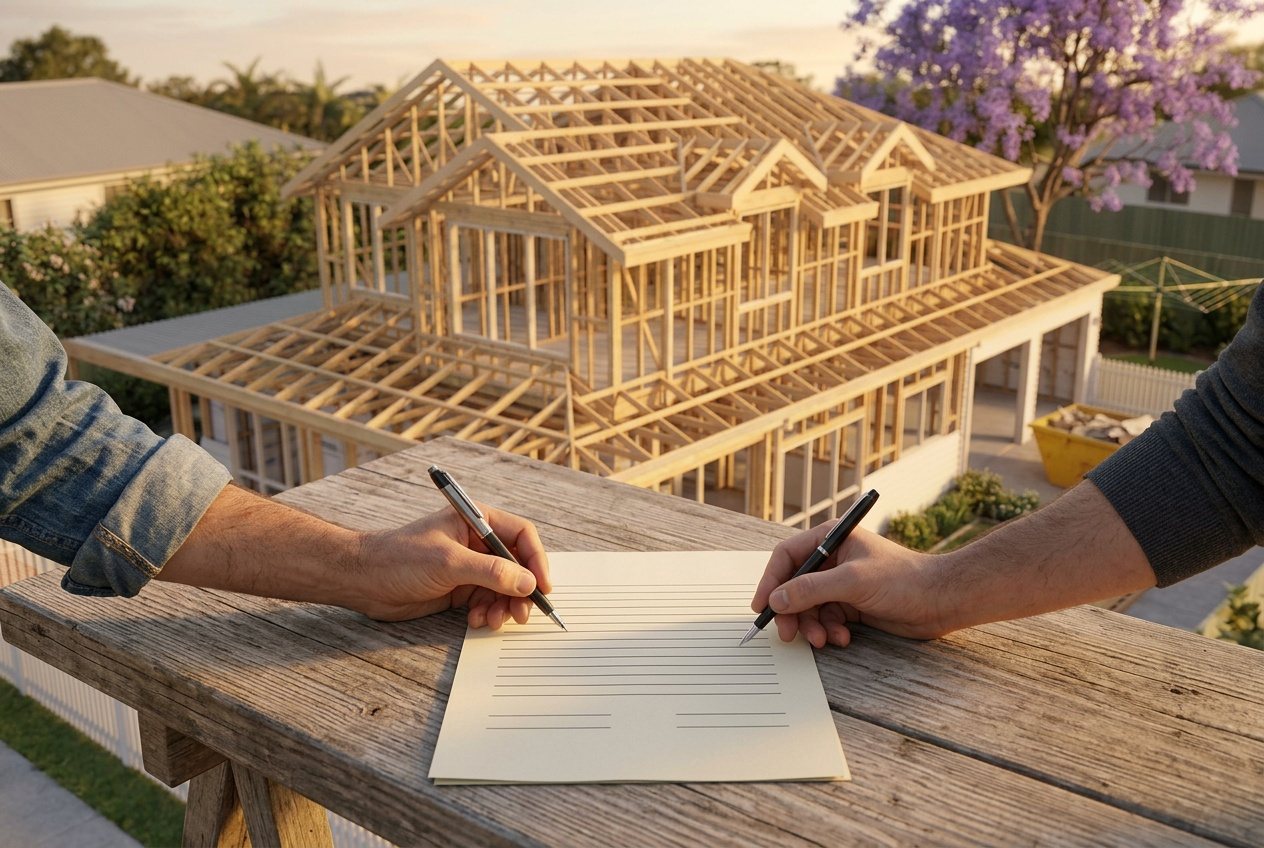 In writing, before the workVariations
Part of a bigger picture: the whole checklist for choosing a builder in Queensland.
What is a variation?
The guide's definition: any change to the materials used or work to be performed under the contract. Three kinds turn up on a house build.
- Ones you ask for. A different benchtop, a bigger deck, a window moved. Your call, your cost, in writing first.
- Ones the site forces. Rock where the soil test didn't find it, an old septic tank nobody knew about, a council condition on the approval. Real, and the contract should say how they're priced.
- Ones the builder creates. A measurement missed, a product ordered wrong, work that has to be redone. Those are not variations you pay for.
What does the law require?
“All variations must be agreed in writing by the home owner before the variation work commences and any price increase due to the variation can not be required to be paid until the variation work is started.”
Queensland Building and Construction Commission, Consumer Building Guide, version 3, effective July 2023 (sections 40–41 of Schedule 1B). Not a courtesy. The rule.
The QBCC's variations page adds the timing: the builder has to give you the written variation before the earlier of the variation work starting, or five business days after you both agreed to it. In person, by post or by email all count.
What must the variation document say?
The QBCC lists it. A variation document must include:
- A description of the variation.
- The date it was requested.
- The builder's reasonable estimate of any delay to the work.
- The change to the contract price, or the method for calculating it, and when the extra is payable or the credit is given.
You respond in writing to say whether you agree. If the variation changes the value of the job, the builder is responsible for amending the Home Warranty cover.
A text message saying “yep go ahead” is writing. It is not the document above. Ask for the document.
What's the urgent exception?
If the variation work has to be done urgently and it isn't reasonably practicable to produce a written copy first — the QBCC's example is safety — the work can go ahead and the paperwork follows promptly. Think a collapsing trench or a live service found where it shouldn't be. Not a benchtop.
When is it the builder's cost, not yours?
This is the part the rules don't spell out and a fair builder does.
- Fixing the builder's own error. A wall in the wrong place, a beam undersized, a window ordered the wrong size. Rectifying that is the builder's obligation under the statutory warranties, not a variation to you.
- Work the contract already covers. If it's in the plans and specifications, it's in the price. Read the specification before agreeing to pay for something “extra.”
- Work done without the written agreement. If the variation wasn't agreed in writing before it started, the builder is on the wrong side of the rule. Get advice before paying.
Site-forced variations sit in between. Rock is nobody's fault. What matters is that the contract said how unforeseen site conditions would be priced, and that the variation is documented the same way as any other.
How do you keep the number down?
The QBCC's advice is to keep variations to a minimum because they're the most common cause of cost overruns and disputes. Practically:
- Finish the design before you sign. Every decision made after the contract is a variation.
- Choose the selections before you sign. Tiles, tapware, appliances. Allowances are where prices drift.
- Get the soil test and the surveys done first. Fewer surprises in the ground.
- Read the specification. Know what's in the price so you know what isn't.
Common questions
The builder did the extra work and is now asking us to pay. Do we have to?
If it wasn't agreed in writing before the work started, the builder hasn't followed the rule. Write to them setting that out, and if it isn't resolved, the QBCC's Early Dispute Resolution service is free. Get advice before you refuse outright; the answer depends on what was said and when.
Can a variation move the completion date?
Yes. The delay estimate is in the document for that reason, and a variation involving extra work is one of the grounds the Act allows for an extension of time. Agree the delay when you agree the price.
Can we get a credit for taking something out?
A variation can reduce the price as well as increase it. The document should state the credit and when it's given.
How does Sabre handle a change that's our fault?
Ask Nathan, and get the answer before you sign. The right answer is that a builder's error is the builder's cost, and you'll never see it on a variation.
Sources: Queensland Building and Construction Commission, Consumer Building Guide (version 3, effective July 2023) and Contract variations (reviewed 27 June 2025); Schedule 1B, Queensland Building and Construction Commission Act 1991. Read 17 September 2026. This is a plain-English guide, not legal advice.
Keep reading
 The rules, in plain wordsProgress payments
Progress payments: what you pay, and when, on a Queensland house build
Deposit limits, claims that must match work on site, the commencement notice, practical completion, and the QBCC's warning that paying early cuts your Home Warranty protection.
 The QBCC's own wordsFixed price or cost-plus
Fixed price or cost-plus: what do builders mean, and which protects you?
The two ways a contract can set the price, in the regulator's own words. What each shifts onto you, why the QBCC warns about cost-plus, and what to check before you sign.
 The nine things that move itWhat decides the cost
What decides the cost of a knockdown rebuild in Brisbane?
Not a price. The nine things that move it: the old house and what's in it, the block, the overlays, the ground, the size, the finish, the access and where you live meanwhile.
Where most families start
A walk through your house with Nathan.
Ask Nathan how Sabre handles a variation, and what happens when the change is our fault. He'd rather tell you now than in month four.
Book your walk-through with Nathan Call 0422 831 306
Already thinking about a rebuild? The free block check is on the same page.