

Your questions answered · Dealing with a builder
Progress payments: what you pay,
and when, on a Queensland house build.
You don't pay for a house in one go, and you shouldn't pay for it ahead of the work either. Queensland's rules on deposits and progress payments are short, specific and written to protect you. Here they are, with the regulator's own wording, so you know what a normal payment schedule looks like and what to refuse.
 Nathan Brain, carpenter and builder at Sabre
17 September 2026
6 min read
 The rules, in plain wordsProgress payments
Part of a bigger picture: the whole checklist for choosing a builder in Queensland.
How big can the deposit be?
The law sets the maximum, by contract value:
- Under $20,000: 10% of the contract price.
- $20,000 or more (every new house): 5% of the contract price.
- Any price, where more than half the work is done off site (prefabrication, substantial custom work away from the block): up to 20%.
“The maximum deposit allowed (before work starts on site) is: 10% where the total contract price is less than $20,000; 5% where the price is $20,000 or more; 20% for a contract of any price where the value of the work to be performed off-site is more than 50% of the contract price.”
Queensland Building and Construction Commission, Consumer Building Guide, version 3, effective July 2023 (sections 33–34 of Schedule 1B). A builder asking for more is asking for something the Act doesn't allow.
What can a progress claim be for?
Work that's been done on your block, in proportion to its value. The guide says owners and contractors are free to choose the number and timing of progress payments, provided the amount claimed is directly related to work progress on site and proportionate to (or less than) the value of the work that relates to the claim.
The QBCC's own example: the contractor can't claim more than 50% of the contract price, including the deposit, until at least 50% of the work on site has been completed. Where payments are at intervals rather than stages, the contractor has to support each claim with evidence of the work performed and its value.
What does a normal schedule look like?
Most fixed-price house contracts use stage payments that follow the build. The names vary between contract forms, but the shape is familiar:
- Deposit — within the cap above.
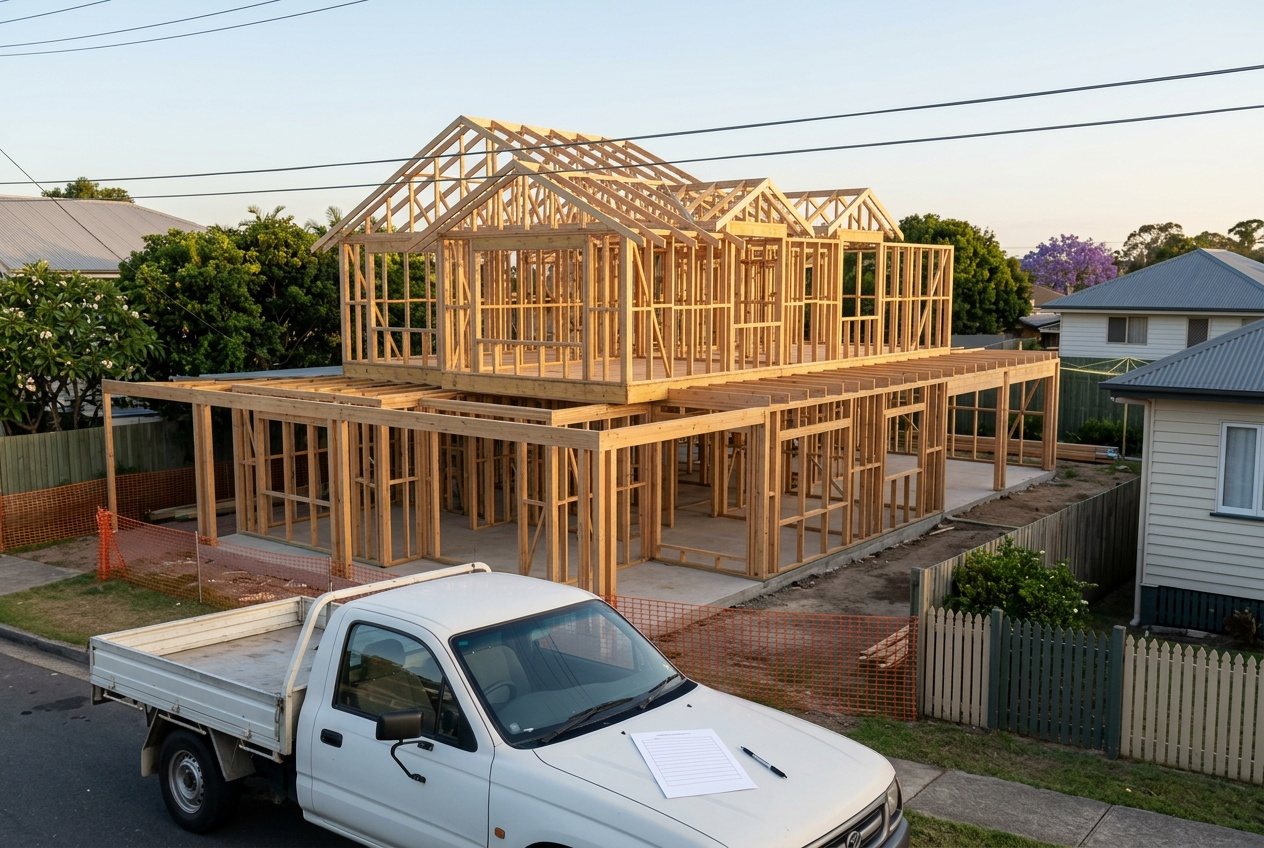
- Base — footings and slab (or the subfloor on a highset) done.
- Frame — the frame up and inspected.
- Enclosed (lock-up) — roof on, external walls and windows in, doors lockable.
- Fixing — internal linings, joinery, fit-out largely complete.
- Practical completion — the final payment.
The percentages against each stage are set in the contract, and they're what to read against the rule above: does each one track the value of the work done to that point? If the “base” stage is a big share of the price on a house with a simple slab, ask why.
What paperwork should arrive along the way?
- The signed contract, with plans and specifications, within 5 business days of entering it.
- A commencement notice, within 10 business days of work starting on site, stating the date work started and the date for practical completion.
- Certificates of inspection from the certifier at the mandatory stages, which the builder must give you as soon as practicable after receiving them.
- Written variations before any changed work starts, and written extension-of-time claims if the completion date moves.
Each payment claim should line up with something on that list. A frame-stage claim with no frame inspection certificate is a question.
When is the final payment due?
At practical completion. The guide says you're not required to make the final payment until all the contracted work is complete in accordance with the contract, plans and specifications, and either without defects or with only minor defects or omissions that won't unreasonably affect occupation. If there are minor items, the builder gives you a defects document listing what's agreed and what isn't, compiled with you at a handover inspection.
Why does paying early hurt you?
Because the Home Warranty Scheme's non-completion cover assumes you've paid according to the contract. If a builder can't finish and you've paid ahead of the work, the scheme's payout is reduced by what you paid that you shouldn't have.
“Never make a progress payment that is more than the amount outlined under the contract, or make the progress payment before the due date outlined under the contract, as this will reduce the protection available to you under the Queensland Home Warranty Scheme.”
Queensland Building and Construction Commission, Deposits and progress payments, reviewed 27 June 2025. Paying early to be helpful is the mistake families make with a builder they like.
Common questions
Can the builder ask for money before the contract is signed?
A deposit is paid under a contract, within the cap. Money for a soil test, a design or a quote is a separate arrangement and should be in writing with what it buys. Be careful with anything described as “holding” a price or a slot.
What if we disagree with a progress claim?
Raise it in writing straight away and ask what work it relates to. The guide's dispute path starts with writing to the contractor, then the QBCC's free Early Dispute Resolution service. Don't withhold payment for completed stages without advice; don't pay for stages that aren't done.
Does the bank pay the progress claims?
On a construction loan the lender usually pays each stage after its own valuer confirms the work, which is one more check on the claim matching the build. Ask your lender how they run it.
What's a “retention”?
An amount held back from the final payment until a defects period has passed. Some contracts have one; many domestic ones don't. If yours does, it's in the contract schedule, and it's not a substitute for the defects document at practical completion.
Sources: Queensland Building and Construction Commission, Consumer Building Guide (version 3, effective July 2023) and Deposits and progress payments (reviewed 27 June 2025); Schedule 1B, Queensland Building and Construction Commission Act 1991. Read 17 September 2026. Thresholds change; check the QBCC's current pages. This is a plain-English guide, not legal or financial advice.
Keep reading
 The QBCC's own wordsFixed price or cost-plus
Fixed price or cost-plus: what do builders mean, and which protects you?
The two ways a contract can set the price, in the regulator's own words. What each shifts onto you, why the QBCC warns about cost-plus, and what to check before you sign.
 Fifteen questionsBefore you sign
What questions should we ask a builder before we sign?
Fifteen questions, most from the QBCC's own checklist: the licence, the contract type, the allowances, the deposit, the dates, the cooling-off, the variations, the warranty, and who you'll talk to in month four.
 Dealing with a builderThe QBCC check
What is the QBCC, and what should you check on a builder's licence?
The regulator, the public register and the Home Warranty Scheme, in plain words. How to look any builder up in five minutes — including us.
Where most families start
A walk through your house with Nathan.
Ask Nathan to walk you through Sabre's payment schedule against these rules, line by line, before you sign.
Book your walk-through with Nathan Call 0422 831 306
Already thinking about a rebuild? The free block check is on the same page.