

Your questions answered · Knockdown rebuild
How to check if your house
is in the character overlay.
Two free checks and about fifteen minutes. One tells you whether your street is protected. The other tells you the year your house went up. You need both answers, and you can get them yourself this weekend.
 Nathan Brain, carpenter and builder at Sabre
10 September 2026
6 min read
 Two free checksCharacter overlay
Part of a bigger picture: the whole knockdown rebuild path, step by step.
Check one: is your property in the overlay?
Council publishes the whole planning scheme, maps included, in a tool called City Plan online.
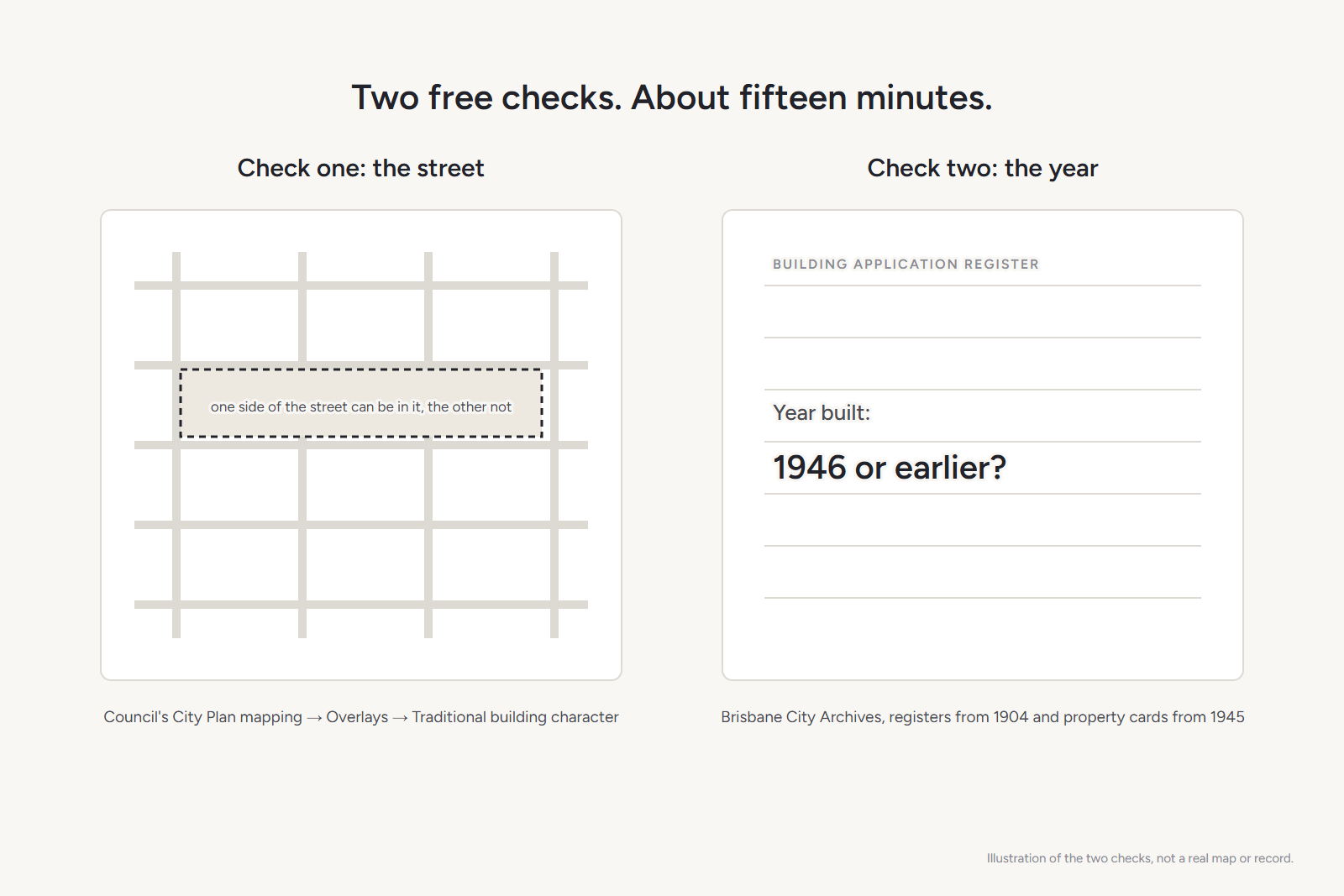
- Go to cityplan.brisbane.qld.gov.au/eplan and type your address into the search.
- Open the map for your property.
- In the Maps Tools panel, turn on the Overlays layers. The one you're looking for is Traditional building character.
- Generate the property report. It's a short summary of the City Plan requirements that apply to your site, and it lists the overlays affecting your lot in one place.
Two things people get wrong here.
- It's mapped street by street, not suburb by suburb. One side of a road can be in the overlay and the other side not. What the neighbours did tells you nothing reliable about your block.
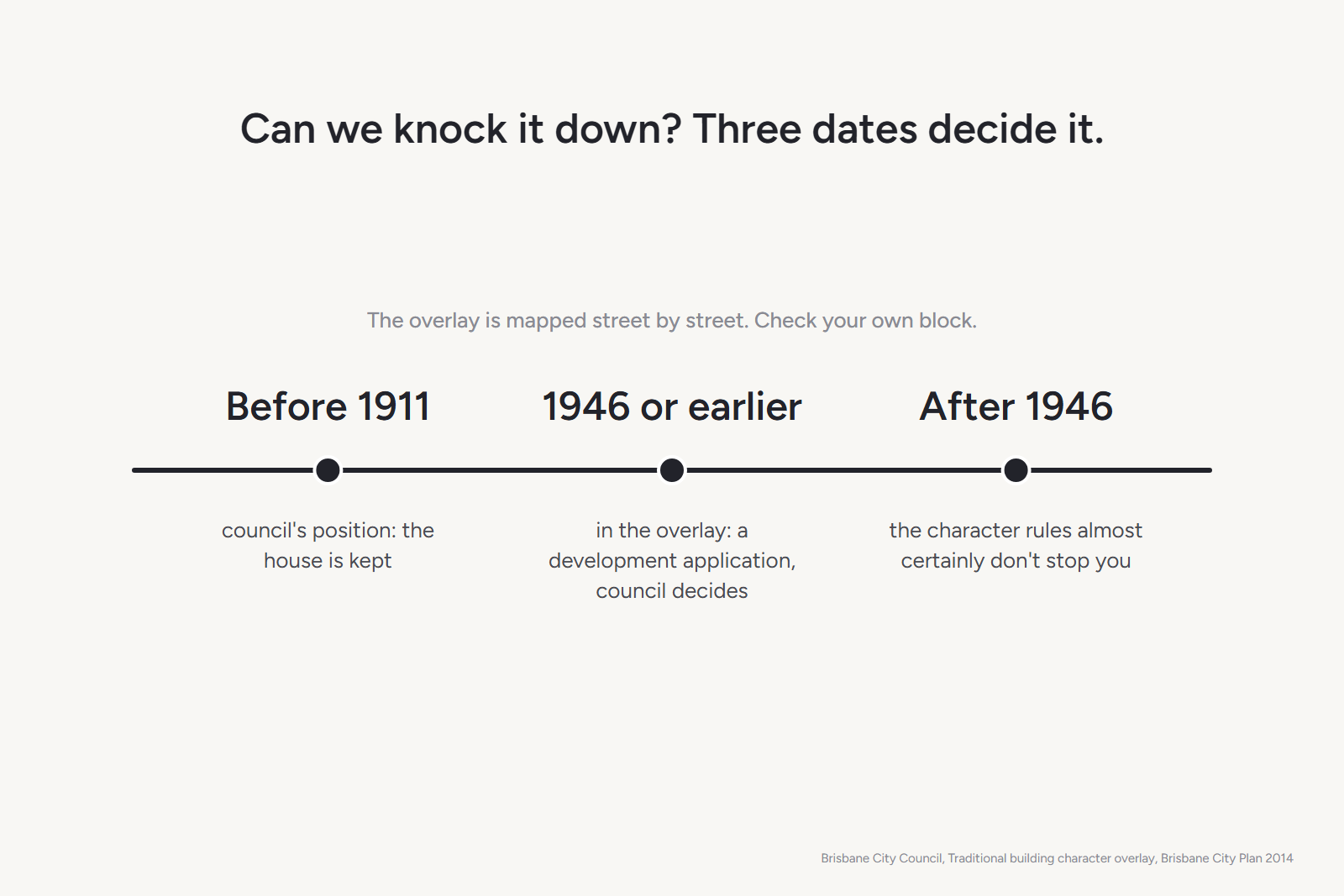
- “In the overlay” is not the same as “can't be touched.” The overlay is about the look of the street. It's what makes demolition of a pre-1947 house something council decides on, rather than something you simply do. The rules, and the limited situations where a pre-1947 house can still come down, are here: Can we knock down our house?
If you'd rather ask a person, council's general number is 07 3403 8888.
The Traditional building character overlay exists “to maintain the traditional, pre-1947 streetscape.”
Brisbane City Council, Brisbane City Plan 2014. That one line is why the year your house was built matters as much as the map does — the overlay protects a streetscape, and the line it draws is 1946.
Check two: what year did your house go up?
This is the question most families can't answer about their own home, and it matters more than the overlay does.
The line is 1946. Built in 1946 or earlier, and the character rules are in play if your street is in the overlay. Built after, and they almost certainly aren't.
Council has a practice note on exactly this — determining the construction date of a building — because it comes up constantly. The records themselves sit with Brisbane City Archives:
- Building Application Registers run from March 1904 to October 1945, arranged by year and indexed by street and by owner's name.
- From November 1945, every building application went onto an individual property card. Those cards record new houses as well as extensions and alterations, and they're searchable.
There are no surviving registers for September 1934 to January 1936 or April to December 1937, and for 1939 and 1941 only the index survives.
Brisbane City Archives, building application registers. If your house went up in one of those windows, a missing record isn't evidence the house isn't pre-1947 — it's evidence the paperwork didn't survive. Worth knowing before you conclude anything.
The Archives are at Moorooka and you can ring them on 07 3403 1711.
Other things that help date a house:
- The title.
- Historical aerial photography.
- The house itself. Stumps, VJ walls, casement windows and a particular kind of roof line tell a builder a lot in about thirty seconds — one reason a walk-through is worth more than a phone call.
What do you do with the two answers?
Four combinations, and they lead different places.
| Your house | Your street | Where that leaves you |
|---|---|---|
| Built after 1946 | Not in the overlay | The character rules aren't your issue. Normal approvals still apply |
| Built after 1946 | In the overlay | Usually fine for the house itself, but the overlay still shapes what a new house looks like from the street |
| Built 1946 or earlier | Not in the overlay | The pre-1947 protections are tied to the overlay, so this is a much simpler conversation than people expect |
| Built 1946 or earlier | In the overlay | Demolition needs a development application and council decides. Not automatically no. Not automatically yes |
If you land in the bottom row, don't assume the answer is no and don't assume it's yes. It's a case to be made, with evidence. Get a builder and a town planner to look at it before you either give up on the block or spend money as though approval is a formality.
And if the house was built before 1911, council's position is that it's kept. That's the one row where the answer is usually the end of the conversation for a full knockdown.
Why do we check this first, every time?
Because the alternative is a family spending months and money on a design for a house that can't be built — or walking away from a block that would have been fine.
It's the first thing we look at, it costs nothing, and you can do it yourself this weekend.
Common questions
Does the overlay stop me renovating?
No. It shapes what work on a pre-1947 house looks like from the street, and it's why some changes need approval that you'd assume wouldn't. Renovating inside the overlay happens all the time.
Is the map ever wrong?
The map is council's, and it changes from time to time. It's the source of truth on the day you read it, which is exactly why you check it yourself rather than relying on what someone told you about the street three years ago.
My neighbour knocked theirs down. Doesn't that settle it?
No. The overlay is mapped street by street, their house may have been a different year, and their application may have been decided on things specific to their house. It's a good sign, not an answer.
Can you check it for me?
Yes. Answer two questions on the contact page and we'll go through it with you, or Nathan will check it while he's at the house.
Sources: Brisbane City Council, City Plan online and Brisbane City Plan 2014; Brisbane City Council practice note on determining the construction date of a building; Brisbane City Archives building application registers and property cards. Record coverage and council mapping change over time — check the current position before you decide anything. This is a plain-English guide, not planning advice.
Keep reading
Can we knock down our house? Brisbane's rules in plain words
The pre-1947 rule, straight from council's own page, and when a protected house can still come down.
What is a knockdown rebuild package, and is it the right way to build?
What an advertised package bundles, who it suits, and six questions worth asking any builder.
Where most families start
A walk through your house with Nathan.
He'll check the overlay with you and walk the house room by room. No obligation, and no need to know what you want yet. He'll ring to set a time that suits the family.
Book your walk-through with Nathan Call 0422 831 306
Already thinking about a rebuild? The free block check is on the same page.